
Domain holder verification
for DENIC Members and Resellers
Since the NIS 2 Directive came into force and was implemented in the BSI Act, DENIC, as the registry for .de domains, has been legally obliged to ensure that the registration details of all domain holders are complete, accurate and verifiable.
This obligation applies not only to newly registered domains, but also to existing domains — including those that have been in existence for many years without any issues.
How does DENIC verify?
DENIC checks a domain’s registration information for anomalies and cross-checks the stored address data against external sources (e.g. public address databases).
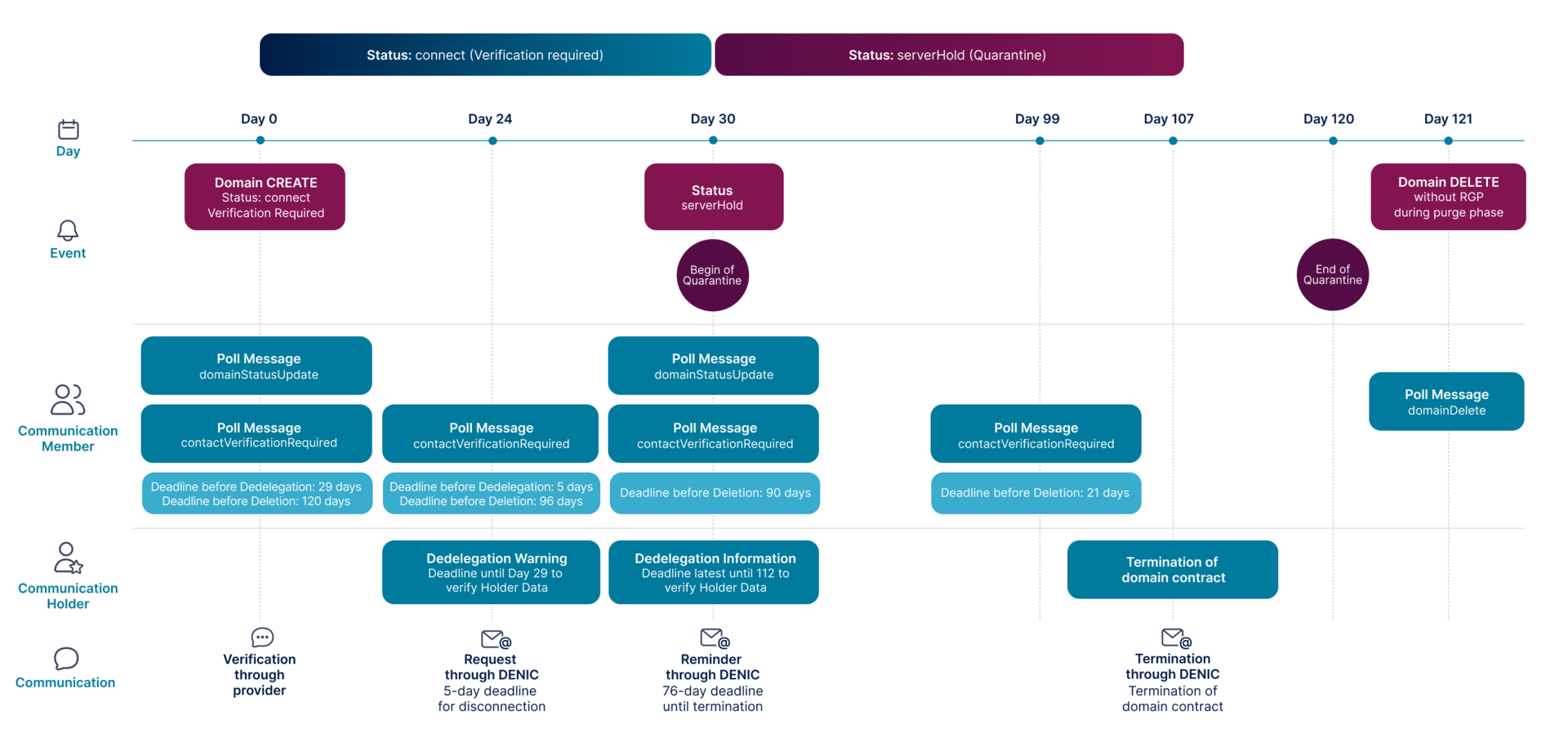
If DENIC cannot check the data independently, the DENIC member is asked to clarify the situation with the holder record and to submit the result of the verification. To this end, the member receives a (poll) message contactVerificationRequired from the registration system.
What data must be verified?
- Full name (for legal persons, including legal form)
- Current postal address
- Telephone number
- e-mail address
What is important for resellers?
- Contact a DENIC member and clarify exactly what the verification processes entail
- The DENIC member can fully implement the processes for their customers or
- The DENIC member can forward the messages to their customers and require them to carry out the verification
- If the domain holder receives an e-mail with a verification request from DENIC, they have only 5 days to complete the verification
- DENIC has no option, even in an emergency, to pause the verification process or postpone deadlines.
Key points at a glance

Important to know

Methods of identity verification
DENIC members or their resellers may decide which verification methods to offer and what supporting documents are required. Domain holders may be offered one or more options, depending on which solution best suits their business model.
Frequently asked questions
DENIC-E-Mail
In most cases, your provider will have already asked you to verify your account around 24 days ago. Please first check your inbox and spam folder for an e-mail from your provider — this will contain specific instructions. If you cannot find it, please contact your provider. You can find detailed steps at the top of this section.
Provider
Your direct contractual partner is usually the provider who invoices you for the domain. You can find the name of the DENIC member who administers your domain in the DENIC system in the DENIC e-mail under ‘Your point of contact’ or via webwhois.denic.de → ‘Domain management information’. In reseller arrangements, these may be different.
In this case, you have probably registered your domain via a reseller — that is, via a hosting provider or a web agency that is itself a customer of a DENIC member. In this scenario, neither the DENIC e-mail nor the webwhois service will show your direct contractual partner, but rather the DENIC member at the end of the chain.
Procedure:
- Contact the provider with whom you actually registered your domain — usually identifiable from your invoices, contract documents or customer account.
- Mention the member named in the DENIC e-mail. Your reseller will forward the verification request down the chain to this member.
- If your reseller does not respond or is unable to help: Contact the DENIC member named in the e-mail directly — they can refer you to the correct point in the chain.
DENIC has been providing its members with comprehensive information on the new legal requirements for over 18 months; such cases are the exception. Please ask your provider to contact the department responsible for DENIC verifications internally. In reseller scenarios, it may help if your provider enquires with their own upstream provider (the DENIC member). DENIC is in constant communication with its members and actively addresses any difficulties that come to light; however, it cannot take over the members’ responsibilities or independently access their databases.
Data
DENIC is legally obliged to check all domain and contract orders for irregularities and to verify address details. To this end, external sources such as address databases are used to identify any potential discrepancies. Even long-standing domains in the portfolio may be affected. If DENIC is unable to verify the data independently, your provider will be asked to clarify the situation with you.
Simply updating or visually checking the data is not sufficient once your domain is undergoing the verification process. The data must be actively verified with supporting documents using one of the permitted methods (e.g. e-mail confirmation, address confirmation, PostIdent, Video-Ident), and the result must be submitted to DENIC by your provider. Please contact your provider and expressly request that they carry out the verification.
Section 49 of the BSIG consists of two paragraphs which must be read separately: Paragraph 2 lists only the minimum information that must be included in the database — but this is not an exhaustive list of all the data that is processed. Paragraph 1 further requires that all registration data be maintained accurately and in full. At DENIC, the address has been part of this registration data from the outset, as otherwise a holder record cannot be uniquely identified — particularly in the case of common names or company names. Consequently, the address is also subject to the statutory duty of care and must be verified.